
What Are Context Clues?
Context clues are the words, phrases, or sentences around an unfamiliar word that help readers figure out its meaning.
Connected Skills
There are several skills that depend on students first mastering context clues. When students can unlock word meaning, they can think more deeply and respond more accurately across the entire ELA spectrum.
🧠 Character Skills
Traits, feelings, motivations, and relationships all rely on students understanding the language the author uses to describe characters.
📖 Text-Evidence Questions
Students must interpret key words in the question and in the passage.
Example: What sentence supports that Molly is curious?
To answer correctly, students need to understand words like curious, hesitant, disappointed, etc.
✍️ Word Choice (Revising)
Revising tasks often ask students to choose the best word for tone or meaning. Without context-clue mastery, this becomes guesswork instead of analysis.
📝 ECRs (Extended Constructed Responses)
Many prompts contain a key word that drives the entire response.
For example:
Explain how Kim shows determination in “Camping Trip.”
What The Research Says?
Studies on context-clue instruction demonstrate that teaching students how to infer word meaning from surrounding text leads to measurable gains in vocabulary and overall understanding (Baumann et al., 2002).
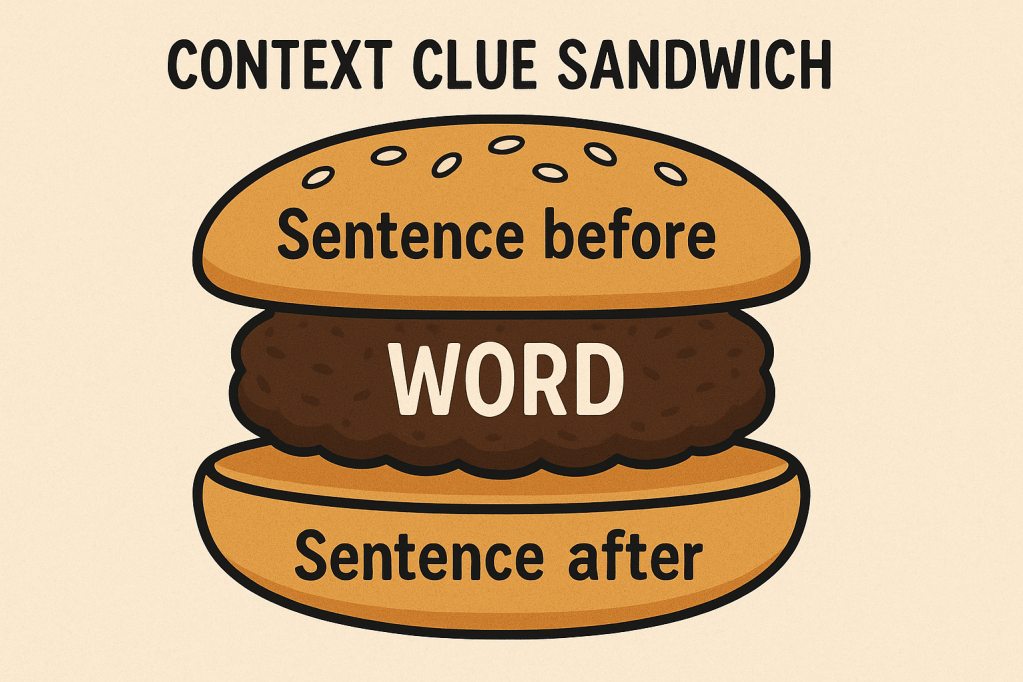
Connected Skills Strategy #1: The Clue Sandwich
One effective way to teach context clues is through a routine I call the Clue Sandwich. In this strategy, students build a “sandwich” to organize the clues around an unfamiliar word:
- Top Bun: Key words or ideas from the sentence before
- Meat: The target word itself plus important nouns/verbs in the sentence
- Bottom Bun: Key words or ideas from the sentence after
By modeling how to gather clues from both sides of the unknown word, students learn to infer meaning using surrounding context rather than guessing. After practicing the routine, many students begin using the Clue Sandwich naturally during independent reading and even on assessments when determining word meaning.
Ultimately, vocabulary growth opens the door to deeper comprehension, and learning this essential skill accelerates that process—driving higher achievement across every area of literacy.
Coming Up: Main Idea of Paragraph, Summary, Inference
References
Baumann, J. F., Edwards, E. C., Boland, E. M., Olejnik, S., & Kame’enui, E. J. (2002). Vocabulary tricks: Effects of instruction on the use of word-learning strategies in reading. Reading Research Quarterly, 37(2), 166–185.
Fisher, D., & Frey, N. (2014). Better learning through structured teaching: A gradual release of responsibility model. ASCD.
Graham, S., & Perin, D. (2007). Writing next: Effective strategies to improve writing of adolescents in middle and high schools. Alliance for Excellent Education.
Nash, H., & Snowling, M. (2006). Teaching new words to children with poor vocabulary skills: Direct learning vs. context-based learning. Journal of Child Psychology and Psychiatry, 47(9), 955–965.
 The Phenomenal Student