What is Bloom’s Taxonomy?
Bloom’s Taxonomy is a framework for classifying educational objectives, originally developed by Benjamin Bloom and his colleagues in 1956. It includes six levels of thinking: knowledge, comprehension, application, analysis, evaluation, and creation (though I personally prefer the term synthesis).
Many of the skills students learn are grounded in this rigor matrix and serve as a guide for instructional decision-making.
In this article, I’ll share my experience using these six levels to foster critical thinking, self-efficacy, and interdependence in the classroom for Revising and Editing.
Intro: Why Texas Needed a Literacy Reset
In 2019, Texas redesigned its ELA (English Language Arts) TEKS to streamline instruction, increase rigor, and elevate the role of writing in the curriculum.
As part of this redesign, the STAAR assessment shifted from separate Reading tests (grades 3–8) and standalone Writing tests (grades 4 and 7) to a combined exam in which Reading and Writing now carry equal weight.
The Problem: A System Unprepared for Writing Rigor
This transition posed significant challenges. For years, many schools—and the curricula they relied on—prioritized Reading almost exclusively. Suddenly, campuses were expected to devote equal instructional time, support, and planning to Writing as well.
The impact was immediate: scores dropped sharply. In fact, performance declined so drastically that the passing standard fell to 33 percent—a full 23-point difference from the long-standing Reading passing standard.
Why the struggle? Many students were unprepared for the two most demanding components of the redesigned exam:
- The Extended Constructed Response (ECR) — 20% of the test
- Revising and Editing — 40% of the test
1. Purpose of Study: Can Explicit Instruction Close The Gap
Traditionally, grammar instruction was treated as an add-on—either a short activity attached to a reading lesson (regardless of the curriculum) or something embedded only within the Revising portion of writing.
Last year, I wanted to see what would happen if Grammar and Revising were taught explicitly and systematically, following the progression of Bloom’s Taxonomy. I implemented this approach with a group of students who began the year at 43 percent proficiency in this area.
2a. Framework: Grammar Through Bloom’s Taxonomy
I begin with Grammar—because without a strong grammatical foundation, students cannot truly master Revision.
After all, a student can’t effectively revise a sentence if they cannot determine whether it’s simple, compound, or complex, or if they haven’t developed the syntactic awareness needed to manipulate language with intention.
The structure of the approach is simple and consistent:
Day 1: Identify the Skill
(e.g., verb tense, adjectives, conjunctions)
Day 2: Comprehend the Skill
(e.g., categorizing examples, such as “Cap or No Cap”)
Day 3: Apply the Skill
(integrated into authentic Reading or Writing tasks)
Day 4: Editing Practice or Skill Analysis
(students analyze errors, patterns, or sentence structures)
Day 5: Assess or Compose a Draft
(demonstrating mastery through editing or writing)
2b. Framework: Revising From Words To Text
Once students have mastered the essential grammar skills, I shift to teaching Revising explicitly. Instead of using the Day 1–5 cycle, I follow a rigorous progression, moving from simple to complex concepts.
A. Word-Level Skills
- Word Choice
- Transitions
B. Sentence-Level Skills
- Revising Sentences
- Combining Sentences
- Combining Ideas (Short Constructed Response)
C. Paragraph/Text-Level Skills
- Identifying the Central Idea
- Adding or Deleting Sentences
- Crafting Effective Conclusions
Throughout this progression, I pre-teach the metacognitive strategies students need to internalize and apply each skill—ensuring that their improvements in Revising are rooted in intentional thinking, not guesswork.
3. Methodology: A Three-Step Assessment Cycle
Assessing student growth was actually very straightforward.
1. Pre-Assess using the previous year’s STAAR test
📄 This established a baseline and highlighted the specific gaps in Grammar and Revising.
2. Track growth using class and district assessments
📊 Ongoing data checks ensured I could monitor progress, adjust instruction, and target small-group needs.
3. Post-Assess using the current year’s STAAR test
🎯 This provided a final, objective measure of student mastery.
The specific skills assessed may vary from year to year, but the STAAR remains a reliable data point—especially because there’s no human grading involved. ✔️
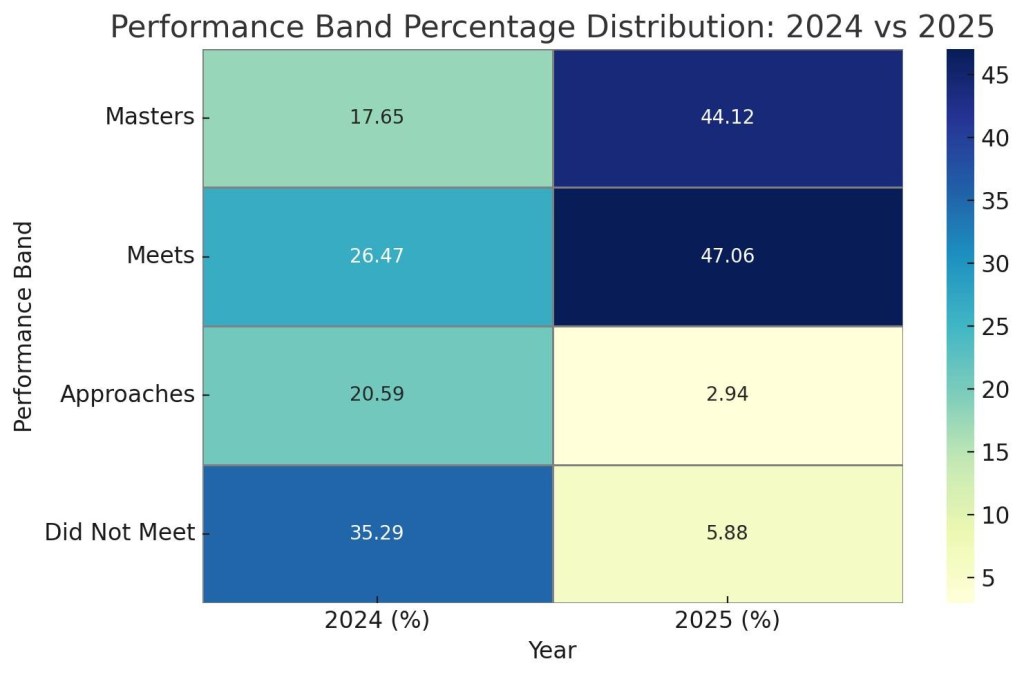
4. Results: One Year, 47-Point Growth
From 2024 to 2025, my students increased their proficiency from 44.12% to 91.18% — more than doubling their performance.
- +26.47% in Masters
- +20.59% in Meets
One caveat:
The only student who did not reach at least Approaches had significant attendance challenges, which impacted their overall progress.
5. Discussion: Integrating Grammar, Revising, and R.I.P.E.
Moving forward, my goal is to replicate—and ideally exceed—the 2025 results with my 2026 group, a cohort that shows many of the same initial gaps in Grammar, Revising, and overall writing readiness.
To accomplish this, I am intentionally expanding and refining my instructional approach. This includes:
- Increasing student engagement through more interactive routines, performance tasks, and student-led discussions
- Embedding deeper sentence-level instruction, especially around syntactic awareness, sentence combining, and purposeful language choices
- Integrating Revising directly with my ECR framework, R.I.P.E. , ensuring that students see how these skills connect and transfer across all parts of the assessment
By strengthening alignment between Grammar, Revising, and the Extended Constructed Response, I aim to build writers who not only perform well on STAAR but also develop the confidence, clarity, and control needed to write with intention across genres.
6. Conclusion: Scaling Explicit Across Texas
I’ll continue refining this approach with the long-term goal of making it replicable and scalable across grade levels, campuses, and even districts.
If more educators and systems adopt a unified, explicit progression that connects Grammar, Revising, and the ECR, we may finally begin to close the longstanding gap between Reading and Writing performance on the STAAR.
More importantly, we can position Texas to align more effectively with the new literacy landscape, where writing is not an add-on—but an essential component of comprehension, communication, and student success.
If you’re interested in learning more about Explicit ELA-Revising and Editing, or would like to schedule professional development focused on this approach, feel free to email me at:
📩 thephenomenalstudent@gmail.com
Jeremiah Short
Educator & Developer of Explicit ELA
 The Phenomenal Student