
What is Close Reading?
Close Reading is a technique that can be used for small or whole group instruction. To conduct the routine, you take a passage and have kids read it multiple times for multiple purposes. The first read is for literal or basic comprehension. The second read is for a deeper dive into higher-level concepts(Ex: Main Idea, Analyze Characters, Inference). The third reading is for evaluating and synthesizing.
*Ideally, small group Closed Reading is better for on or above-level readers.
How to Conduct Close Reading
Materials Needed: Post-It, Highlighters(Teacher and Student), Document Camera
Resource: Complex Text
For the purposes of this article, I’ll use a poem to model Closed Reading.
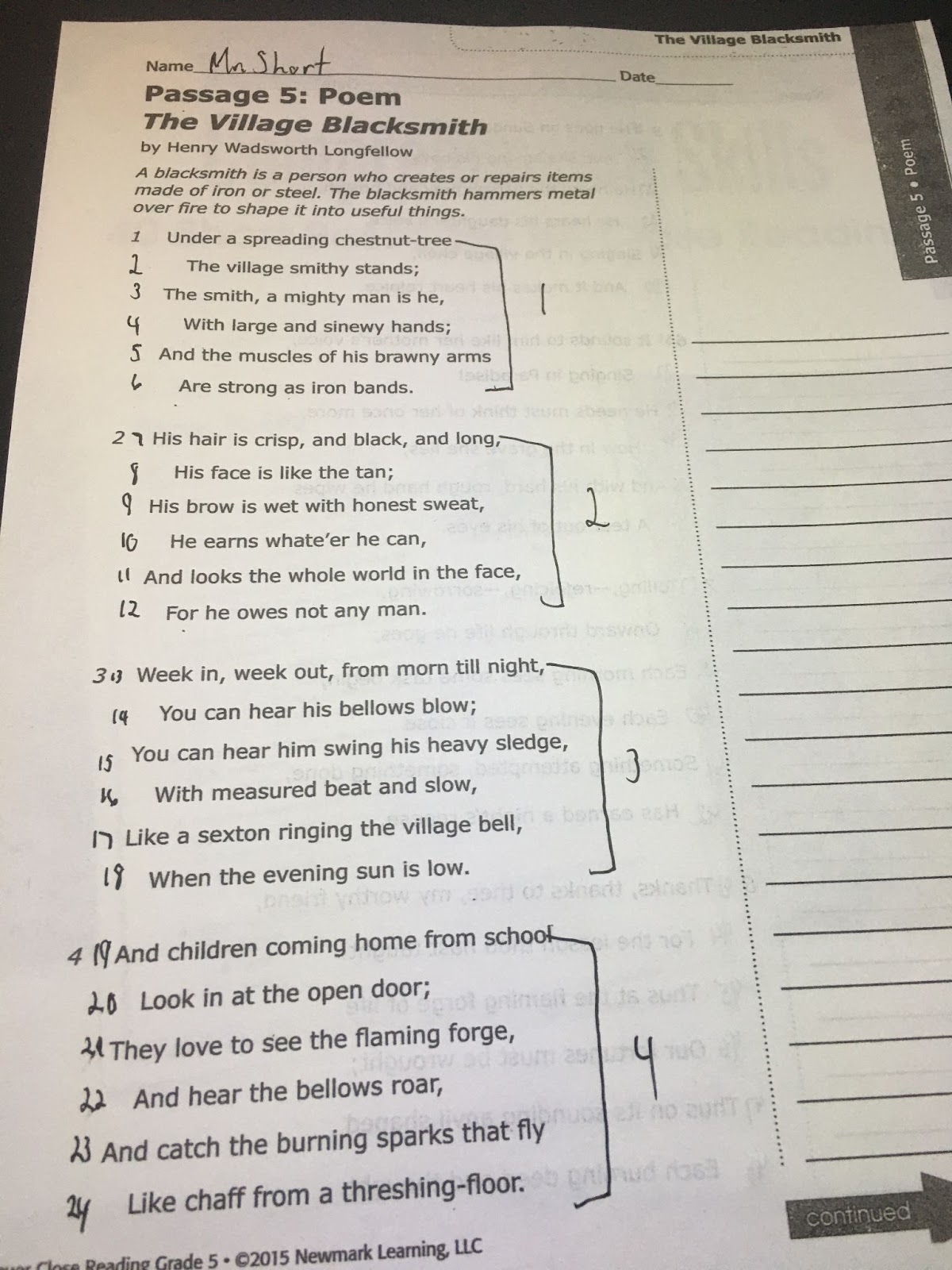
First Read: Number The Lines, Stanzas and Circle Rhyming Words
Before I have students analyze a poem, they number the lines, stanzas and circle rhyming words. The reasoning for this is to slow scholars down, so they’ve already know the gist in preparation for answering the higher-order questions.
*This should take around 5 minutes.
2nd Read: Deeper Dive
Stanza 1 Question: What is the speaker describing/telling you about in Stanza 1?
This is a good question to determine if the scholars understand the Main Idea of an individual stanza.
Example Answer: The stanza is describing/telling us about the physical characteristics of the Village Blacksmith. My evidence is that the speaker talks about his hands and the muscles in his arms.
Stanza 2 Question: What does “looks the whole world in the face” mean?
With this question, you get to assess if kids understand figurative language and facilitate a discussion.
Example Answer: Looks the whole world in his face means that he has a serious and mature look to him.
Stanza 3 Question: Does the Village Blacksmith work hard? If so, what’s your evidence?
This is a good question to further develop scholars ability to analyze and evaluate the text.
Example Answer: Yes because In the third stanza, the speaker writes “from morn till night.” Hard workers will go all day to complete tasks.
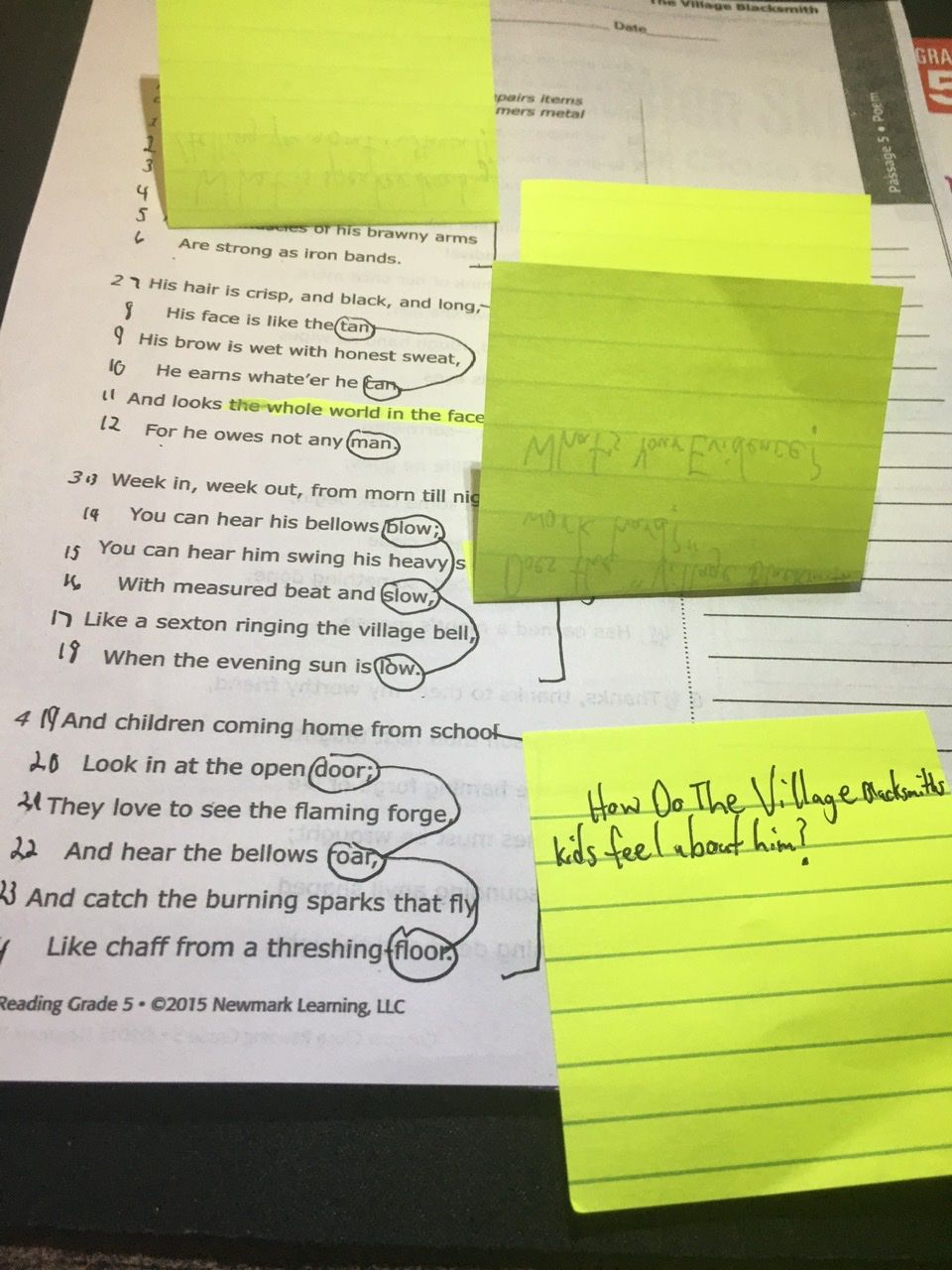
Stanza 4 Question: How does the Village Blacksmith’s kids feel about him?
A good question to see if students can use evidence to interpret Character Feelings.
Example Answer: They love their dad because it says “They love to see the flaming forge.”
Stanza 5 Question: Why does the Village Blacksmith enjoy going to church?
This question requires that the scholars analyze the text deeply.
Example Answer: He enjoys going to church because he likes to hear his daughter’s voice.
Stanza 6 Question: Why does the Village Blacksmith become emotional?
Again, another question for the scholars to read deeper into the text.
Example Answer: I think he became emotional because his daughter’s voice reminded him of his wife that passed away , and he was reminiscing on past times.
Stanza 7 Question: What is the speaker/author doing in this stanza?
Before the scholars answer the question, ask them to pay attention to each line and word.
Example Answer: The speaker is summarizing the events in the poem up to this point. For example, he/she writes: “Toiling, rejoicing,–sorrowing.”
Stanza 8 Question: Do you think the speaker appreciates the Village Blacksmith?
This question requires that scholars evaluate the final stanza of the poem.
Example Answer: Yes. I think he appreciates the Village Blacksmith because he calls him “my worthy friend.”
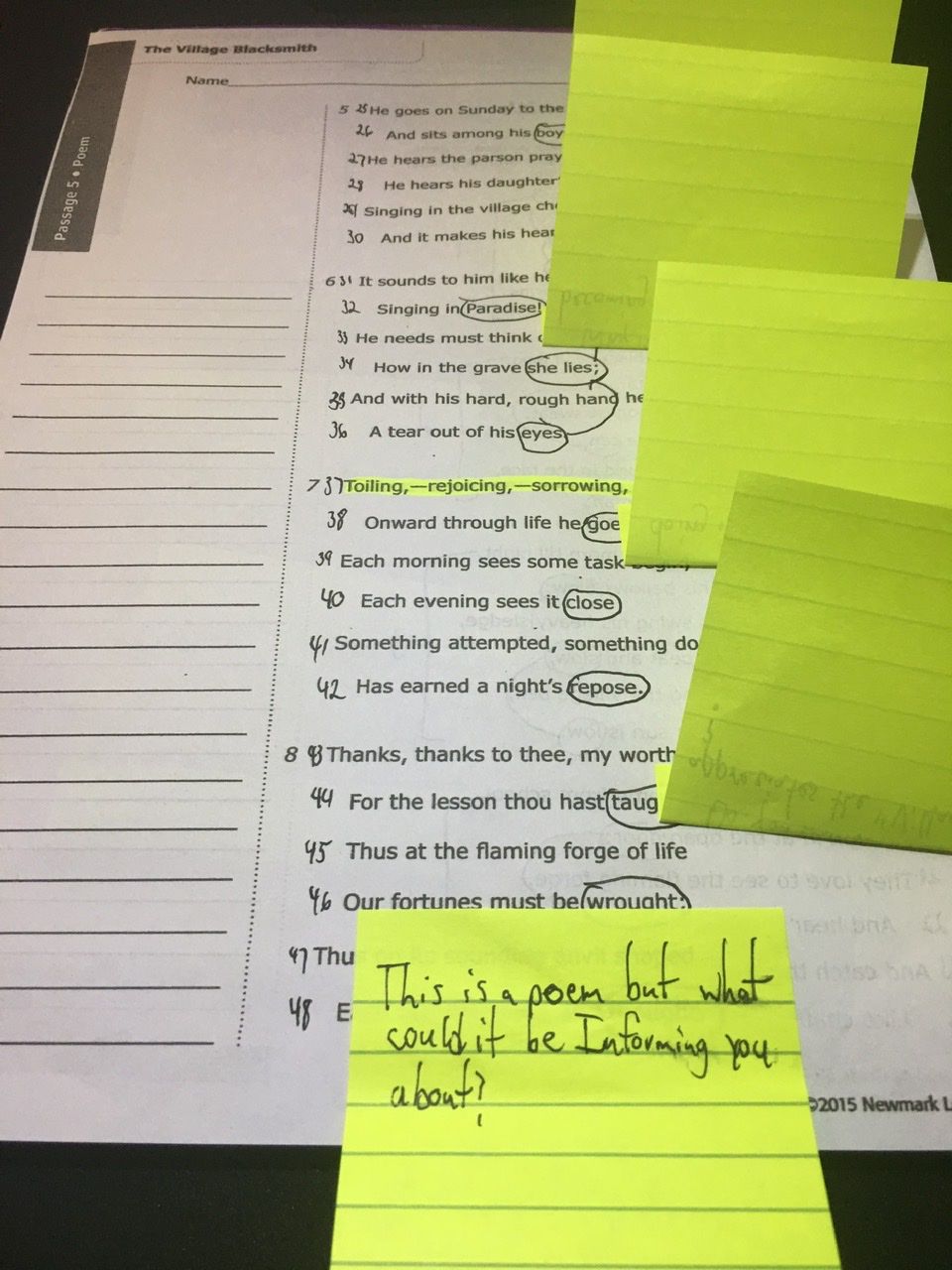
Final Read: Divergent Thinking
Whole Poem Question: This is a poem, so it’s written to entertain but what other purpose could it serve?
This is a good question to show students that text can be written for multiple purposes.
Example Answer: It could serve the purpose of informing you about the life of a Village Blacksmith during those times.
Benefits of Close Reading
Interactive: While conducting the Close Reading, scholars are constantly doing something. Reading, Talking, Highlighting, Annotating or Writing.
Scaffolded: It’s a good routine to support weaker readers with comprehension because the teacher is correcting misconceptions and they hear the thoughts of other classmates while having collaborative discussion.
Purposeful: With each Close Reading scholars learn to ask the proper questions as they read text and organically slow down.
Conclusion: Close Reading is a routine that should be a key component of any ELA(English/Language Arts) Instructional Block 2-12(Not proper for K-1). It aids in students monitoring for comprehension and fosters higher-order thinking.
Be Phenomenal, Mr. Short
Up Next: Text Analysis
 The Phenomenal Student