Bloom’s (Taxonomy) Unit: Traditional Literature
Last year, I experimented with structuring my Reading lessons according to the levels of Bloom’s Taxonomy. Every concept within a genre would be covered following which level of Bloom’s it was and I would follow Bloom’s within the week I covered the concept.
For example.
Expository Text
Knowledge: Identify Expository Text
Comprehension: Main Idea
Comprehension: Text Structure
Apply: Author’s Purpose
Analyze: Inference
Evaluate: Test
Synthesis: Create an Expository
Coming into this next year, I wanted to take it to the next level. Originally, I anticipated mastering the structure in the upper elementary grades, but I moved to 2nd grade, so I had to adapt for my scholars to command the content.
Over the course of the year, I’m chronicling my journey to change the way Reading is taught. I’ll discuss the progression, questioning and conclude with the Unit success.
First Unit: Fiction
Levels of Bloom’s By Concept
Traditional Literature(Knowledge)
Elements of Plot(Comprehension)
Describe Characters(Apply)
Inference/Theme(Analyze)
Assessment(Assessment)
Create A Story(Synthesis)
First Concept: Identify Characteristics of Traditional Literature
Knowledge: Identify the type of traditional literature
To introduce the concept, I built upon the kids’ prior knowledge by displaying a picture of Frozen characters. I asked the kids to name the characters and then asked them to say the movie. They responded(in unison): “Frozen!!!”
After reviewing the anchor chart, I did an interactive Read-Aloud: Mufaro’s Beautiful Daughters. Then I went through the gradual release progression.
Modeled Instruction: Anansi and the Fisherman
We(Do): The Princess and the Pea
During the partner work, I interviewed one of my students…asking him how he got the answer. He responded: “Its identical(to the anchor chart).”
You(Do): The Hare and the Tortoise
With this being their first independent practice of the year, the kids struggled without additional support.
Comprehension: Explain the type of Traditional Literature
Video-Aloud: Ants and the Grasshopper
To start the lesson, I played the Ants and the Grasshopper. Utilizing the QSSSA(Question, Signal, Stem, Share, Answer) routine, I asked them to figure out what type of Traditional Literature. After a little time and support, they figured out that it was a Fable.
Shared Reading: My Own Self
I went through a folktale with the kids…modeling how to determine the type of Traditional Literature.
We(Do): The Story of Yen
I let the students work in partners again. I interviewed a student about how he found his answer.
The student: It a fairytale “Once upon a time” at the beginning and “ever after” at the end.
Apply: Classify the types of Traditional Literature
Audio-Aloud: How Tiger Got His Stripes?
I wanted to encourage higher order thinking by letting the kids know that it was a folktale but asking: How is it not a Fable? I got some great responses.
Answer #1: “The animals don’t act like humans. They act like animals.”
Answer #2: “There was a problem.”
Answer #3: “There wasn’t a lesson.”
We(Do): Classify Traditional Literature
The kids worked in groups to classify the three traditional literature they must master: Folktale, Fable and Fairy Tale. They all classified perfectly.
Analyze: Compare/Contrast two similar Traditional Literature
To help the kids analyze, I utilized the TRTW(Talk 1, Read, Talk 2, Write) routine.
Talk 1: Animated Lion King/Live-Action Lion King
For the Talk 1, I showed a clip of the animated and live-action Lion King. Then I asked the kids the difference between the two.
Answer #1: One is a cartoon. One is real.
Answer #2: The scar is different in the real one.
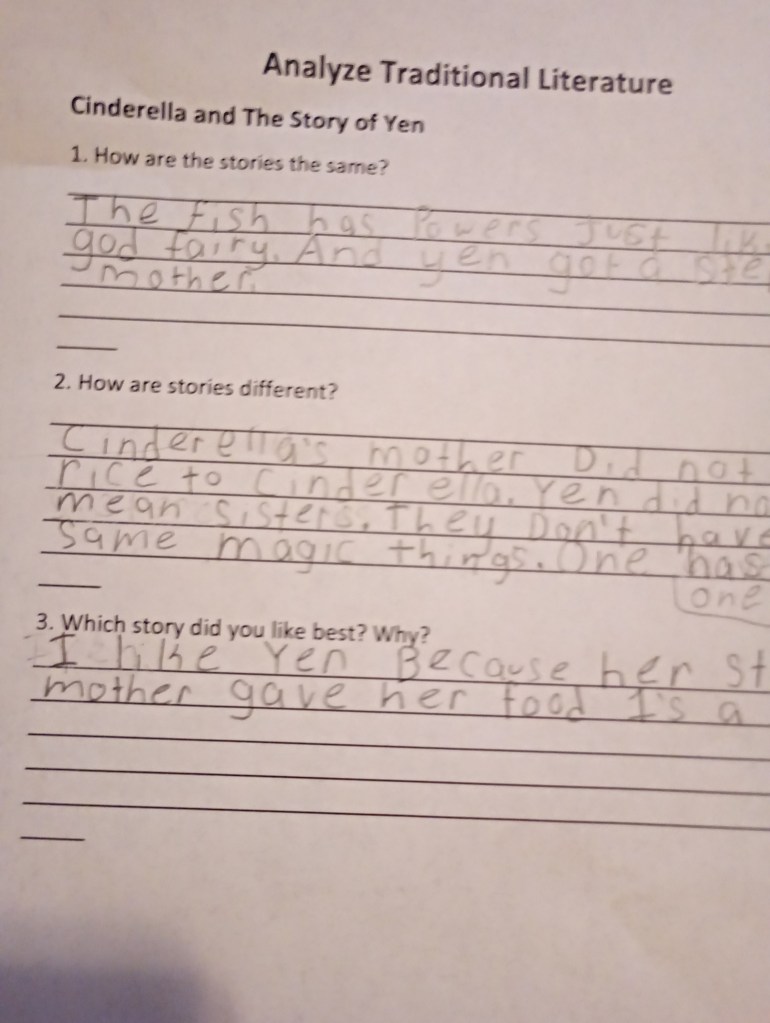
Read: Cinderella/The Story of Yen
I scaffolded by reading the stories to the kids. Then before they would read themselves, I set the purpose for their reading by giving them three questions: How were the stories the same, different and which story did you like the best?
Talk 2: Discuss Cinderella/Story of Yen
Following the read portion of the TRTW, the kids discussed the three questions with their classmates.
Write: Answer the questions.
After the kids answered the questions, I let them share out. Here are a few responses.
How are they the same?
Answer #1: Both have stepmothers, chores and a girl.
Answer #2: Both have stepsisters who are mean.
Answer #3: They both have courage that they will be a princess one day.(I know, excellent response.)
How are they different?
Answer #1: One has a glass slipper. One has a golden slipper.
Answer #2: One has a prince…the other has a king.
Answer #3: One has a godmother. One has a goldfish.
Which one did you like?
There weren’t a lot of responses for this one.
Evaluate: Quiz
You(Do): Gallery Walk
I let the kids to participate in a gallery to assess their mastery of Traditional Literature. My first real mistake of the week was not giving them the support of the anchor chart. They struggled to remember the details. (I’ll file that away for next time.)
Synthesis: N/A
Unit Success: 80 %
Next Concept: Elements of Plot
Jeremiah Short, Educator
 The Phenomenal Student